
Creator Platform Business Model Map: How the Revenue Actually Works
Learn how creator platforms make money through subscriptions, PPV, tips, live interactions, marketplace fees, and SaaS pricing. This guide explains take rates, creator payouts, unit economics, and the key decisions founders should validate before building a creator platform MVP.


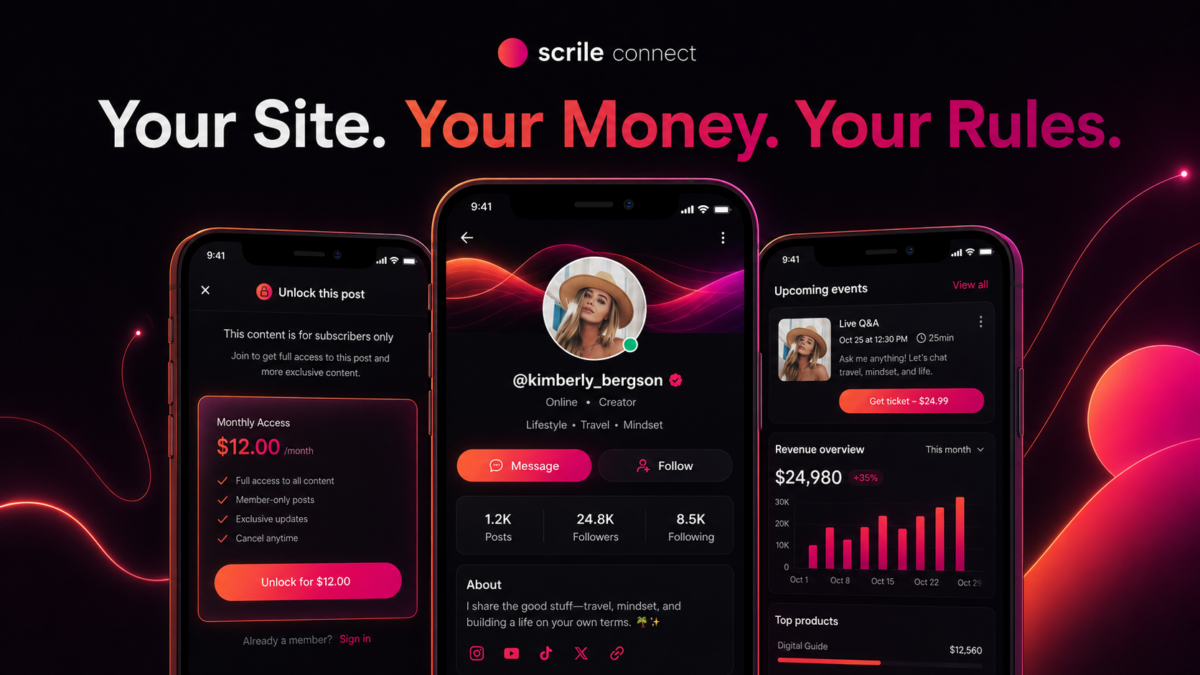
Creator platform founder in a modern studio with monetization dashboard on screen
A creator platform business model explains how money moves between users, creators, and the platform owner.
It is not simply a choice between subscriptions, pay-per-view content, or advertising. A viable model must answer five connected questions:
- Who pays?
- What are they paying for?
- How much does the creator receive?
- What does the platform retain?
- Which costs must be covered before the platform makes a profit?
Most creator platforms combine several revenue streams. Fans may pay for subscriptions, premium content, private messages, tips, live sessions, digital products, or AI interactions. The platform may earn through a percentage of these transactions, a fixed subscription paid by creators, additional service fees, advertising, or a combination of these models.
The right creator platform business model depends on where the platform creates value. A marketplace that brings creators new customers can justify a transaction commission. A software product that helps creators monetize an audience they already have may be better suited to a monthly SaaS fee. A live cam platform needs to account for performer payouts and streaming costs, while an AI companion platform must track the cost of every generated message, image, and voice interaction.
This guide maps the main revenue models, compares several creator economy business models, and shows how to test the economics before building the platform.
Quick answer: how creator platforms make money
Creator platforms usually make money in one or more of the following ways:
- keeping a percentage of creator transactions;
- charging creators a recurring software fee;
- charging fans for subscriptions, credits, or premium access;
- collecting fees on marketplace transactions;
- selling advertising, sponsorships, or premium placement;
- charging for additional services such as payouts, promotion, analytics, or account management.
The platform’s revenue is not the same as the total amount users spend.
If a fan spends $100 and the creator receives $80, the platform may record $100 in gross merchandise value, or GMV, but only $20 in gross platform revenue. Payment processing, refunds, chargebacks, support, moderation, infrastructure, and payout costs must still be deducted from that $20.
That distinction is the foundation of creator platform unit economics.
What a creator platform business model must include

A business model should describe more than the price displayed on the checkout page. It should show the complete flow of money and value through the platform.
A simplified transaction looks like this:
Fan payment → payment processing → platform revenue → creator balance → creator payout
Several different financial metrics appear inside this flow.
Gross merchandise value
Gross merchandise value is the total amount users spend through the platform during a given period.
Depending on the product, GMV can include:
- membership subscriptions;
- pay-per-view purchases;
- tips;
- paid messages;
- live session charges;
- digital product sales;
- marketplace bookings;
- token or credit purchases.
GMV shows how much economic activity takes place on the platform. It does not show how much the platform earns.
Creator payouts
Creator payouts are the amounts owed or paid to creators, performers, experts, sellers, or other providers.
The payout may be calculated as a fixed percentage of a transaction. It may also vary by creator tier, product type, referral source, agency agreement, or individual contract.
Gross platform revenue
Gross platform revenue is the amount retained by the platform before its operating costs are deducted.
It may include:
- the platform’s take rate;
- creator subscription fees;
- payment or payout fees;
- listing fees;
- premium account fees;
- advertising revenue;
- paid add-ons;
- service and management fees.
Contribution margin
Contribution margin shows what remains after variable costs connected to generating the revenue are deducted.
A simplified formula is:
Contribution margin = platform revenue − variable transaction and delivery costs
Depending on the platform, those costs may include:
- payment processing;
- refunds and chargebacks;
- payout costs;
- fraud losses;
- streaming infrastructure;
- AI model usage;
- storage and content delivery;
- usage-based moderation;
- customer support linked to transaction volume.
Fixed costs such as salaries, legal services, product development, and general marketing are normally deducted later when calculating operating profit.
Creator platform revenue model map
The table below provides a practical map of the most common revenue streams.
| Revenue stream | Who pays | How the platform earns | When it works best | Main risk | Product requirements |
|---|---|---|---|---|---|
| Membership subscriptions | Fan or member | Percentage of each subscription or direct subscription revenue | Creators deliver recurring value | Churn and failed renewals | Recurring billing, access control, creator payouts |
| Pay-per-view content | Fan | Commission on each unlock | Premium content has clear standalone value | Irregular purchase frequency | Paywalls, previews, media delivery, purchase history |
| Tips and virtual gifts | Fan | Percentage of each tip or markup on credits | Audiences have a strong emotional relationship with creators | Revenue may depend on a small number of high spenders | Wallet, tipping interface, balances, fraud controls |
| Paid messages | Fan | Commission, message price, or credit markup | Direct creator access is valuable | Creator workload limits scale | Messaging, media attachments, pricing rules, notifications |
| Live sessions | Fan or client | Per-minute share, session commission, or access fee | Real-time attention is the main product | Streaming and moderation costs | Video infrastructure, timers, billing, session controls |
| Digital products | Buyer | Sales commission or listing fee | Creators sell reusable files, courses, or downloads | Low repeat purchase rate | Storefront, file delivery, licenses, refunds |
| Creator SaaS fee | Creator or agency | Fixed monthly or annual subscription | Creators bring their own audiences and need business tools | Pre-revenue creators may cancel quickly | Account tiers, billing, feature limits, onboarding |
| Marketplace commission | Buyer, seller, brand, or creator | Percentage of completed transactions | The platform creates valuable matches or demand | Insufficient liquidity on either side | Search, profiles, booking, escrow or payouts, dispute handling |
| Advertising | Advertiser | CPM, CPC, campaign, or placement fees | The platform owns substantial audience attention | Large scale is needed before revenue becomes meaningful | Ad inventory, targeting, reporting, brand safety |
| Premium placement | Creator or seller | Promotion or listing fee | Discovery affects creator revenue | Can reduce trust in organic discovery | Ranking controls, promotion tools, analytics |
| AI subscriptions and credits | User | Subscription revenue or markup on tokens | Users return frequently for conversations or generated media | Heavy users may consume more than they pay | Usage metering, limits, generation systems, cost analytics |
| Platform add-ons | Creator or business owner | Fixed or usage-based add-on fee | Customers need advanced functionality | Product and support complexity | Modular features, billing, entitlement management |
A platform does not need every row in this table. In most cases, the first version should focus on one primary paid action and one complementary revenue stream.
For example, a fan platform may launch with subscriptions and PPV. A webcam site may begin with paid private sessions and tips. An AI companion platform may offer a monthly subscription with additional token packs.
Four ways a creator platform captures value

Individual monetization features can usually be grouped into four broader platform models.
1. Take rate and revenue share model
In a revenue share model, the platform keeps a percentage of transactions completed by creators.
For example:
- a fan pays $20 for a subscription;
- the creator receives $16;
- the platform retains $4 before its own costs.
The platform take rate in this example is 20%.
This model is attractive at the beginning because platform revenue is aligned with creator revenue. Creators do not have to pay a large fixed fee before they earn anything.
It is commonly used for:
- fan subscription platforms;
- creator marketplaces;
- live cam and video chat platforms;
- tipping products;
- digital product marketplaces;
- booking and consultation marketplaces.
A take rate is easiest to justify when the platform provides value that a creator cannot easily reproduce alone. That value might be customer acquisition, payment processing, trust, content hosting, moderation, discovery, or an established audience.
The weakness appears when successful creators begin comparing the commission with the cost of running their own site. The larger a creator becomes, the more visible the platform fee becomes.
A take-rate model therefore needs a clear answer to this question:
What does the creator continue receiving in exchange for every percentage point of revenue?
2. SaaS subscription model
In a SaaS model, creators, agencies, or business owners pay a recurring fee to use the platform.
The fee may be based on:
- number of creator profiles;
- number of team members;
- available features;
- storage or traffic;
- monthly revenue;
- usage limits;
- service level.
This model works best when creators, agencies, or entrepreneurs use a branded creator platform as the infrastructure for a business they already understand and promote. The customer is paying for software that helps them operate more efficiently or launch an independent product.
SaaS pricing offers more predictable revenue for the software provider. It can also become cheaper for high-earning creators because the fee does not automatically grow with their sales.
However, a fixed fee creates friction for creators who have not started earning. The product must demonstrate value quickly enough to justify the recurring expense.
3. Hybrid model
A hybrid model combines a fixed fee with a smaller transaction commission.
For example, a platform might charge:
- $99 per month;
- plus 3% of transactions;
- plus optional fees for advanced features.
This model can balance predictable revenue with participation in customer growth. It may also help cover costs that increase with transaction volume.
The main drawback is pricing complexity. Customers may struggle to understand the full cost if the platform combines subscriptions, processing fees, commissions, payout fees, and add-ons.
A hybrid model works only when the pricing page can explain the total cost clearly.
4. Consumer and audience monetization
Some platforms earn directly from the audience rather than primarily charging creators.
Examples include:
- subscriptions paid to access the platform itself;
- token packages;
- advertising;
- premium user accounts;
- paid discovery features;
- ticketed events;
- marketplace service fees.
This approach is especially relevant for media networks, livestreaming products, dating platforms, and AI companion businesses.
The platform must continue providing direct value to the user. It cannot rely solely on the presence of creators while charging the audience for an unclear benefit.
Take rate vs SaaS fee vs hybrid model
Founders often begin by asking what percentage the platform should charge. The better first question is what type of value the platform creates.
| Pricing model | Platform earns when | Best suited to | Main advantage | Main weakness |
|---|---|---|---|---|
| Take rate | A creator completes a transaction | Marketplaces and fan platforms | Low upfront barrier for creators | Successful creators may view the fee as expensive |
| Fixed SaaS fee | A creator pays for access to software | Creator tools and owned platforms | Predictable recurring revenue | Difficult to sell to pre-revenue creators |
| Hybrid model | Customer subscribes and processes transactions | Platforms combining software and payments | Covers fixed and volume-based value | Harder to explain |
| Consumer subscription | A user pays for access or benefits | AI, media, dating, and community products | Revenue is not dependent on creator fees | Requires continuous user value |
| Advertising | An advertiser pays for audience attention | Large discovery and media platforms | Users may access the product for free | Requires significant scale and brand safety |
| Marketplace fee | A transaction is successfully completed | Service, booking, and product marketplaces | Revenue reflects marketplace activity | Cold-start and liquidity problems |
A useful decision rule is:
- use a take rate when the platform helps create the transaction;
- use SaaS pricing when the customer brings the business and uses the platform as infrastructure;
- use a hybrid model when part of the value is fixed and part increases with usage;
- charge consumers when the platform itself provides the paid experience.
Creator platform business models by product type
The same monetization method behaves differently across different products. The following models show how revenue, payouts, and costs change depending on the platform.
OnlyFans business model: direct fan transactions

The OnlyFans business model is based on direct payments between fans and creators. Revenue can come from subscriptions, tips, paid content, and other creator transactions.
Founders building an OnlyFans-style creator platform usually apply the same underlying logic: several fan monetization tools operate through one payment, balance, and creator payout system.
OnlyFans pays creators 80% of fan payments and retains approximately 20%. Its parent company reported $7.2 billion in fan payments and approximately $5.8 billion paid to creators for the financial year ending in November 2024.
The important lesson is not simply that the platform charges 20%. The model works because several paid actions use the same financial infrastructure:
- recurring subscriptions;
- tips;
- pay-per-view content;
- direct interactions;
- creator balances and payouts.
This increases the amount each paying fan can spend without requiring a completely different product for every revenue stream.
For an OnlyFans-style platform, the main business variables include:
- number of active creators;
- percentage of creators who generate sales;
- number of paying fans;
- average revenue per paying fan;
- subscription renewal rate;
- PPV purchase rate;
- platform take rate;
- creator payout percentage;
- refunds and chargebacks;
- payment approval rate.
The model may fail when the platform recruits many creators but does not help them reach paying users. A large creator count is not useful if most profiles remain inactive or never receive a transaction.
When this model works
An OnlyFans-style model works best when creators have an audience, a clear paid offer, and a reason to communicate with fans repeatedly.
What the platform must provide
At minimum, the product normally needs:
- creator profiles;
- subscriptions;
- paywalls;
- PPV content;
- messaging;
- tips;
- content management;
- creator balances;
- payouts;
- admin controls;
- moderation and compliance workflows.
Patreon business model: recurring memberships

The Patreon business model focuses on ongoing memberships between creators and their audiences. Creators can offer tiers, recurring benefits, community access, exclusive content, and one-time digital purchases.
For new creator pages published after August 4, 2025, Patreon applies a standard 10% platform fee. Payment processing, payout, currency conversion, taxes, and other applicable costs are separate from the headline platform fee.
This distinction matters for founders. A public platform fee does not necessarily represent the platform’s full cost to the creator or its net margin.
Membership platforms depend heavily on retention. The user is not purchasing only one piece of content. They are agreeing to continue paying for future value.
That value may come from:
- regular premium content;
- access to an archive;
- a private community;
- recognition or supporter status;
- direct communication;
- educational resources;
- early access;
- live events.
Subscriptions can work even when creators do not publish on a rigid schedule, but the member must continue understanding what the recurring payment provides.
Key metrics
The most important metrics for a Patreon-style model include:
- free-to-paid conversion;
- monthly recurring revenue;
- renewal rate;
- subscriber churn;
- average subscription price;
- tier distribution;
- annual plan adoption;
- revenue expansion through upgrades or one-time sales.
Main risk
The main risk is a weak reason to renew. Acquisition can create an attractive first month while churn prevents the platform from building durable recurring revenue.
Twitch monetization model: live attention and community
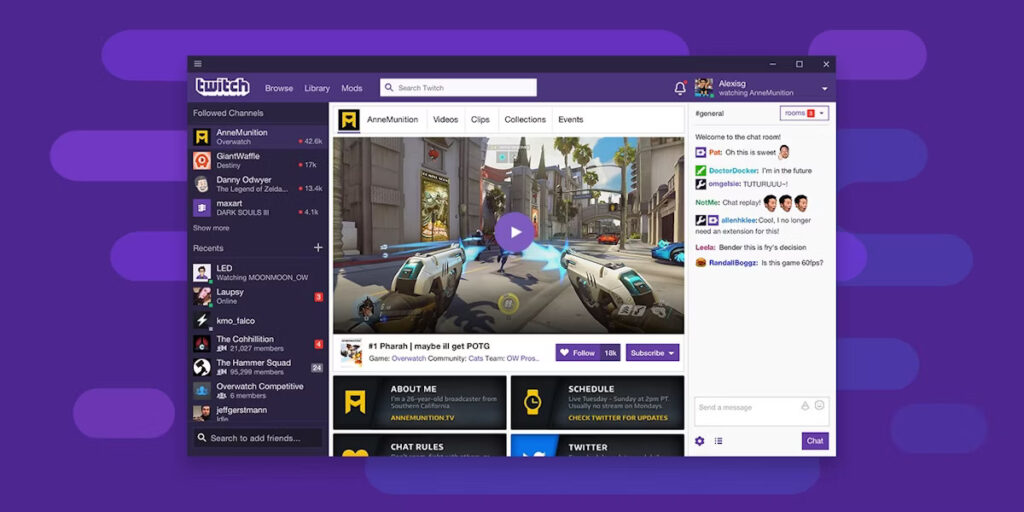
The Twitch monetization model combines several revenue streams rather than relying on one universal transaction.
Eligible creators may earn through:
- channel subscriptions;
- Bits and Cheers;
- advertising;
- other program and commercial opportunities.
Twitch’s Plus Program offers qualifying Affiliates and Partners enhanced subscription net revenue share levels of 60/40 or 70/30, subject to the program’s requirements.
The main lesson for founders is that a live platform can monetize different types of user behavior:
- commitment through subscriptions;
- spontaneous support through virtual gifts;
- attention through advertising;
- exclusivity through premium access.
Live platforms are operationally different from static membership sites. Revenue depends not only on creator supply but also on creators being available at the right time.
Key metrics
Important metrics include:
- active broadcasters;
- concurrent viewers;
- viewing hours;
- paid viewing minutes;
- subscription conversion;
- gift or tip revenue per viewer;
- creator online hours;
- repeat viewer rate;
- streaming cost per active session.
Main risk
Live platforms can have strong engagement but weak monetization if viewers watch without paying. They can also have creators ready to stream when there is insufficient user demand.
The platform must manage both audience liquidity and creator availability.
Live cam platform business model

A live cam or video chat platform usually monetizes real-time access rather than content ownership alone.
Common revenue streams include:
- private pay-per-minute sessions;
- group shows;
- ticketed broadcasts;
- tips;
- virtual gifts;
- premium galleries;
- recorded content;
- subscriptions;
- paid messaging.
The basic money flow is:
User buys credits → user spends credits during interactions → performer receives a payout share → platform retains the remaining share
Credits can make small and frequent payments easier, but they also introduce accounting and product questions:
- When does the platform recognize revenue?
- Do unused credits expire?
- Can users receive refunds?
- How are performer earnings calculated?
- Who absorbs promotional bonuses?
- How does the platform prevent fraudulent spending?
A cam platform may have a higher take rate than a simple subscription tool because it provides real-time infrastructure, user acquisition, support, moderation, performer management, and transaction handling. However, the appropriate percentage depends on what the platform actually provides.
Key metrics
Founders should monitor:
- paid minutes per active user;
- average price per minute;
- conversion from free chat to paid chat;
- performer occupancy rate;
- revenue per performer hour;
- repeat spender rate;
- tip revenue;
- streaming cost per minute;
- performer payout percentage;
- chargeback rate.
Main risk
A live cam platform may recruit many performers but still fail if there are not enough paying users online at the same time.
This is a marketplace liquidity problem expressed in minutes rather than listings.
AI companion platform business model
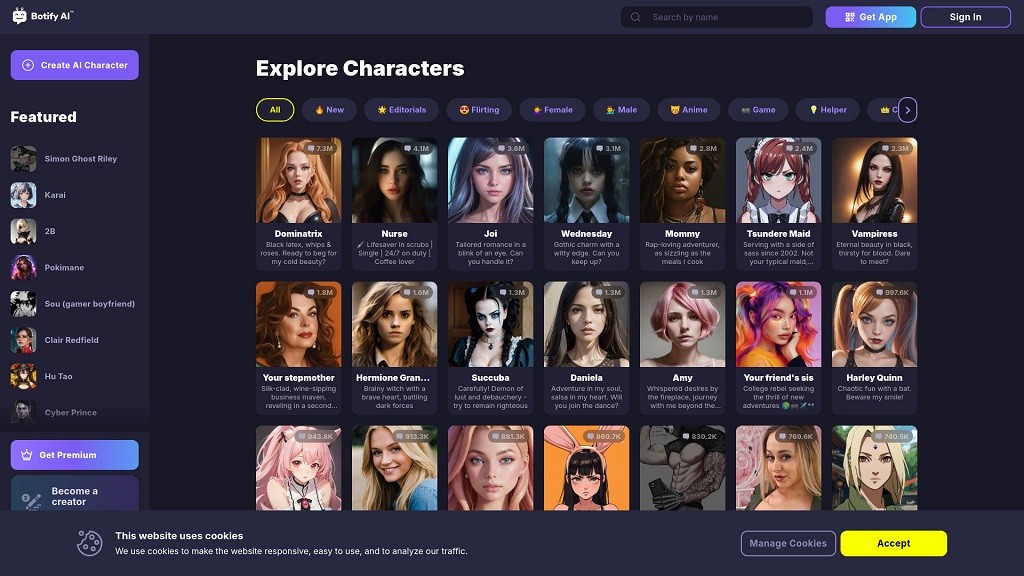
An AI companion platform usually combines recurring subscriptions with usage-based monetization.
Possible revenue streams include:
- monthly or annual subscriptions;
- token or credit packages;
- premium characters;
- paid image generation;
- voice messages or calls;
- longer conversations;
- advanced memory;
- custom character creation;
- exclusive content;
- higher usage limits.
Unlike a creator marketplace, an AI platform does not always pay a human creator after each interaction. However, it has a variable technical cost.
Every message, image, or voice interaction may consume:
- model inference;
- generation APIs;
- GPU resources;
- storage;
- moderation;
- content delivery;
- support capacity.
This means that revenue per subscriber is not enough to understand the model. The founder must also measure the cost of serving each user.
Key metrics
The core metrics include:
- free-to-paid conversion;
- monthly subscription revenue;
- token purchase rate;
- average revenue per paying user;
- messages per user;
- images generated per user;
- generation cost per active user;
- gross margin by subscription plan;
- retention by character or use case;
- percentage of users who reach usage limits.
Main risk
A subscription can look profitable at the average usage level while losing money on heavy users.
Limits, token packs, fair-use rules, and premium generation features should therefore be designed around actual usage costs rather than copied from competitors.
Creator platform unit economics
Unit economics show whether the platform earns enough from each user, creator, or transaction to support growth.
A basic model begins with four formulas.
1. Gross merchandise value
GMV = total value of all completed user transactions
2. Platform gross revenue
Platform gross revenue = GMV × take rate + fixed fees + additional service revenue
3. Variable costs
Variable costs = payment costs + payouts absorbed by the platform + refunds + chargebacks + delivery costs + usage-based support and moderation
4. Contribution margin
Contribution margin = platform gross revenue − variable costs
The calculation should be adapted to the product.
A subscription platform might calculate contribution margin per paying subscriber. A marketplace might calculate it per completed transaction. A live cam platform may calculate it per paid minute. An AI platform might calculate it per active subscriber or per 1,000 generated interactions.
Illustrative unit economics example
Consider an early fan platform with the following monthly results:
| Metric | Illustrative value |
|---|---|
| Paying fans | 1,000 |
| Average monthly fan spend | $35 |
| GMV | $35,000 |
| Platform take rate | 20% |
| Gross platform revenue | $7,000 |
Now assume the platform has the following variable costs:
| Variable cost | Illustrative value |
|---|---|
| Payment processing and transaction costs | $1,400 |
| Refunds, chargebacks, and fraud losses | $525 |
| Payout-related costs | $175 |
| Variable support and moderation | $900 |
| Hosting and content delivery | $500 |
| Total variable costs | $3,500 |
The resulting contribution margin would be:
$7,000 − $3,500 = $3,500
The contribution margin rate on platform revenue would be:
$3,500 ÷ $7,000 = 50%
This does not mean the business has made a $3,500 profit. The platform must still cover fixed costs such as product development, salaries, legal work, sales, and marketing.
All figures in this example are illustrative. Actual costs vary significantly by payment provider, country, risk category, content type, transaction size, and product architecture.
Unit economics change by platform type
| Platform type | Primary unit | Main revenue driver | Important variable cost |
|---|---|---|---|
| Membership platform | Paying subscriber | Subscription price and retention | Payment fees, content delivery, support |
| Fan platform | Paying fan or creator | Fan spend and platform take | Payments, payouts, chargebacks, moderation |
| Live cam platform | Paid minute | Price per minute and paid usage | Performer payout, streaming, support |
| Creator marketplace | Completed transaction | GMV and commission | Payment costs, disputes, account management |
| Creator SaaS | Paying creator account | Subscription price and account retention | Support, hosting, onboarding |
| AI companion platform | Active paying user | Subscription and credit purchases | AI generation, storage, moderation |
A platform can have positive transaction margin and still fail because acquisition is too expensive.
For that reason, the full business model must eventually include:
Customer lifetime value > customer acquisition cost
However, founders should avoid calculating lifetime value from only one or two months of data. Retention must be observed long enough to make the estimate credible.
What makes a creator platform business model fail

A platform can have functioning payments and still lack a viable business model.
The following failure points appear across creator, marketplace, live streaming, and AI products.
No clear reason to pay
Users may enjoy the content or interaction but still see no reason to purchase.
The paid offer must provide an understandable benefit, such as:
- exclusive access;
- personal attention;
- saved time;
- entertainment;
- status;
- a completed service;
- premium media;
- better functionality.
Adding more payment buttons does not solve weak value.
Insufficient creator supply
A marketplace needs enough relevant creators to satisfy user demand.
The problem is not simply the total number of registered creators. The platform needs creators who are:
- active;
- available;
- appropriate for the audience;
- able to deliver the promised value;
- willing to follow the platform’s commercial rules.
Insufficient user demand
Recruiting creators before establishing a realistic acquisition channel can produce an empty marketplace with many profiles.
Founders need to know where paying users will come from:
- creator-owned audiences;
- paid advertising;
- affiliates;
- search traffic;
- partnerships;
- communities;
- organic platform discovery.
Low repeat purchase rate
A first purchase proves that the checkout works. It does not prove that the business is sustainable.
Recurring subscriptions, repeat PPV purchases, continued live sessions, and additional token purchases are usually more valuable than a large number of one-time buyers.
Platform fee exceeds perceived value
Creators accept a fee when they understand what it pays for.
A take rate becomes difficult to defend when the platform provides little discovery, weak support, limited functionality, or no clear advantage over an owned website.
Payment approval problems
A strong conversion funnel can still lose revenue if legitimate payments are declined.
Payment method availability, country coverage, risk policies, recurring billing support, and merchant approval should be evaluated before launch rather than after the platform starts recruiting creators.
Refunds and chargebacks consume the margin
A commission may look attractive until reversals and disputes are included.
The business model should establish:
- who is responsible for refunds;
- whether the creator’s balance can become negative;
- whether reserves are required;
- how disputes are handled;
- which party pays dispute fees;
- when funds become available for payout.
Creator payout complexity
Creator earnings may involve minimum payout amounts, verification, payout schedules, multiple currencies, agencies, referral shares, and tax documentation.
A platform that cannot explain balances and deductions clearly will create distrust even when the calculations are technically correct.
Moderation and compliance costs are ignored
User-generated content platforms need policies, reporting tools, review workflows, account controls, and escalation procedures.
These requirements are especially important for age-restricted, dating, adult, livestreaming, and AI-generated content products.
Revenue depends on a small number of accounts
A platform may appear healthy while most revenue comes from one creator, one buyer, or a few high-spending users.
Concentration risk should be measured directly.
Useful metrics include:
- share of GMV generated by the top 10 creators;
- share of revenue generated by the top 10 buyers;
- percentage of active creators with at least one sale;
- revenue retained if the largest account leaves.
How to choose the first revenue stream
The first monetization model should follow the first repeatable value exchange.
Ask:
What is the smallest action that proves the platform creates value?
Examples:
- a fan starts a paid subscription;
- a user unlocks premium content;
- a client books a consultation;
- a viewer pays for a private live session;
- a buyer hires a creator;
- an AI user purchases a token pack.
Build the initial revenue model around that action.
A common mistake is launching subscriptions, PPV, tips, paid messages, digital products, advertising, and premium listings at the same time. The founder gains flexibility, but users face too many decisions.
A more practical sequence is:
- Launch one primary paid action.
- Confirm that users complete it.
- Measure repeat behavior.
- Identify the next unmet purchasing need.
- Add a complementary revenue stream.
- Measure whether it increases revenue without reducing conversion or trust.
For example:
- start with memberships, then add PPV;
- start with private paid sessions, then add tips;
- start with creator subscriptions, then add paid add-ons;
- start with AI subscriptions, then add token-based image generation.
The second revenue stream should expand proven demand rather than compensate for a weak first offer.
What to validate before building a creator platform MVP
Before building a creator platform MVP, founders should validate the business model behind it. The following questions help determine whether the first version has a realistic path to transactions, repeat usage, and platform revenue.
Customer and value
- Who is the first paying customer?
- What exact result or experience are they buying?
- Why would they pay here instead of using a larger platform?
- Is the purchase recurring, transactional, or usage-based?
- How frequently can the paid action realistically happen?
Creator supply
- Who will provide the content, service, or interaction?
- Do these creators already have an audience?
- How will the first creators be recruited?
- What will motivate them to remain active?
- How quickly can they earn their first payment?
Platform revenue
- Will the platform use a take rate, SaaS fee, consumer subscription, or hybrid model?
- What is included in the headline price?
- Which additional fees may apply?
- Will the pricing still feel reasonable when a creator grows tenfold?
- Can the business model be explained in one short paragraph?
Costs and risk
- Who pays processing and payout costs?
- Who absorbs refunds and chargebacks?
- What moderation is required?
- Which costs increase with usage?
- Does the product require reserves or delayed payouts?
- Which customer segment may be difficult to process?
Growth
- Who brings the audience: the platform or the creator?
- What is the first acquisition channel?
- What must happen for a customer to purchase again?
- Which metric will show that the model is ready to scale?
- How dependent is the platform on its largest creators?
These questions should be answered before advanced features are added to the MVP.
The next step is to translate the selected model into a launch scope: payment, access, content or interaction delivery, creator earnings, payouts, and essential admin controls.
Where Scrile fits into the business model
Different creator businesses require different technical foundations.
Scrile Connect
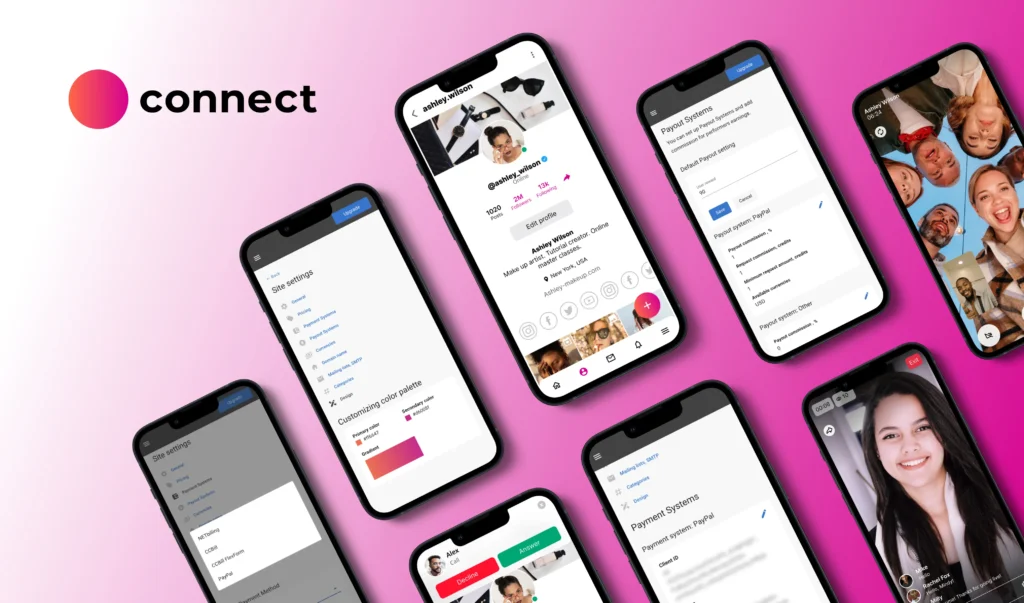
Scrile Connect is designed for branded creator, fan, membership, and content monetization platforms.
Its built-in monetization options include subscriptions, tipping, pay-per-view content, private video calls, live streams, mass messaging, and content bundles. Platform owners can use their own branding, domain, payment setup, content rules, and pricing policies.
Scrile Connect is most relevant for:
- OnlyFans-style platforms;
- independent creator websites;
- creator agency platforms;
- paid communities;
- niche membership products;
- platforms combining subscriptions, PPV, tips, and messaging.
The platform owner decides how the business earns. This may involve charging creators a commission, using a fixed membership fee, operating a hybrid model, or building custom monetization rules.
Scrile Stream
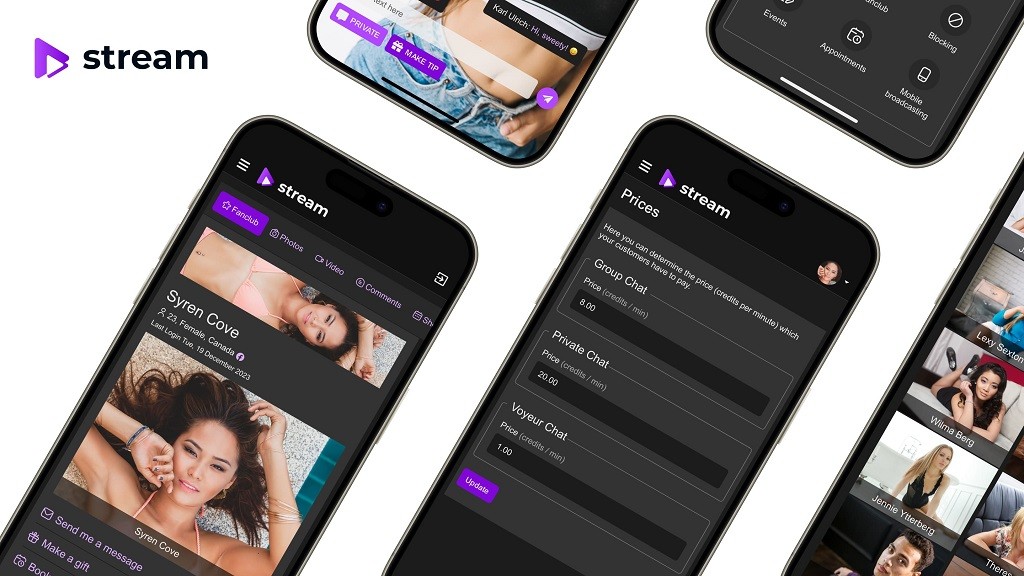
Scrile Stream is designed for live video, webcam, coaching, consulting, and paid communication platforms.
It supports private and group video interactions, tips, premium galleries, paid sessions, and flexible pay-per-minute modes.
Scrile Stream is most relevant when the core paid action is:
- a private live session;
- a paid group broadcast;
- a per-minute interaction;
- live coaching;
- entertainment;
- a consultation.
Because streaming usage creates variable costs, the pricing model should be tested against paid minutes, performer payouts, infrastructure, and support.
Scrile AI
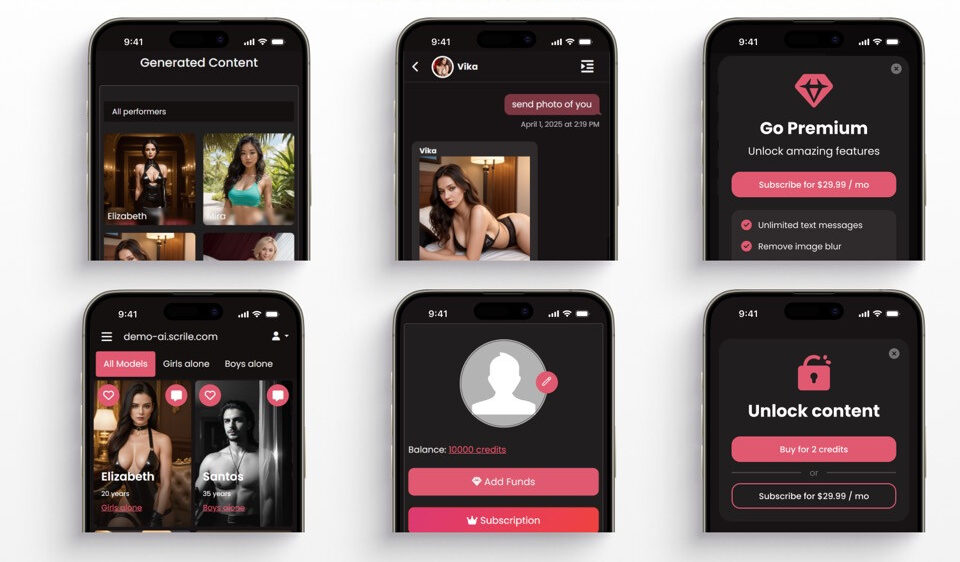
Scrile AI is designed for branded AI companion and AI character products.
Its monetization options can combine subscriptions, tokens, premium characters, message limits, paid images, image generation, voice features, and custom pricing logic.
Scrile AI is most relevant for:
- AI companion platforms;
- virtual character products;
- AI friend applications;
- AI coaches or tutors;
- AI creator monetization;
- entertainment and roleplay products.
For this model, founders should connect pricing directly to the cost of AI usage. Subscription limits and token prices should be based on real generation costs and user behavior.
Final takeaway
A creator platform business model is not a list of monetization features. It is a system that connects user payments, creator value, platform revenue, payouts, and operating costs.
The strongest model is not necessarily the one with the highest take rate. It is the one that:
- gives users a clear reason to pay;
- gives creators a clear reason to participate;
- covers transaction and delivery costs;
- supports repeat purchases;
- remains defensible as creators grow;
- can be explained without hidden fees or complicated assumptions.
Start with one paid action. Map the money from the customer to the creator and the platform. Deduct the real variable costs. Then add new revenue streams only after the first exchange is working.
Once the business model is clear, the next step is deciding what the first version of the platform must contain.
Plan the first version of your platform
Once you have selected a revenue model, the next step is deciding which features are required to process the first transaction and which ones can wait.
Read the next Scrile Academy guide: How to Build a Creator Platform MVP.
Frequently asked questions
What is a creator platform business model?
A creator platform business model describes how a platform creates value, collects payments, compensates creators, and retains revenue. It includes the paid offer, pricing model, take rate or subscription fee, creator payouts, payment costs, operating expenses, and conditions required for repeatable growth.
How do creator platforms make money?
Creator platforms make money through transaction commissions, creator subscription fees, user subscriptions, advertising, premium placement, marketplace fees, payment-related charges, digital product sales, and paid add-ons. Many platforms combine several of these revenue streams.
What is a platform take rate?
A platform take rate is the percentage of transaction value retained by the platform. If a user spends $100, the creator receives $80, and the platform retains $20, the platform take rate is 20%. The retained amount is gross platform revenue, not necessarily profit.
What is the difference between GMV and platform revenue?
GMV is the total value of transactions processed through the platform. Platform revenue is the portion the platform retains through commissions, fees, subscriptions, or other charges. A platform may process $1 million in GMV while recording only a fraction of that amount as revenue.
How does the OnlyFans business model work?
The OnlyFans business model is based on direct fan payments for creator subscriptions, tips, premium content, and other transactions. Creators receive 80% of fan payments, while the platform retains approximately 20% before covering its own operating costs.
Should a creator platform charge a SaaS fee or revenue share?
A revenue share usually fits platforms that help create transactions, bring demand, or manage a marketplace. A SaaS fee is more suitable when creators bring their own audiences and use the platform mainly as business infrastructure. A hybrid model can combine both approaches when the platform provides fixed software value and transaction-based services.
Which revenue stream should a new creator platform launch first?
The platform should begin with the simplest paid action that proves users receive value. This might be a subscription, PPV purchase, paid live session, marketplace booking, or token purchase. Additional revenue streams should be added after the first transaction loop and repeat behavior have been validated.
What costs should be included in creator platform unit economics?
Unit economics may include payment processing, creator payouts, payout fees, refunds, chargebacks, fraud, content delivery, streaming, AI generation, storage, moderation, and variable customer support. Fixed expenses such as salaries, legal work, and product development should also be considered when calculating total profitability.
What is the biggest risk in a creator marketplace business model?
The biggest risk is insufficient liquidity. The platform needs enough relevant and active creators as well as enough paying buyers. A marketplace with many profiles but few completed and repeated transactions does not have a sustainable economic model.
Can one creator platform use several monetization models?
Yes. A platform may combine subscriptions, PPV, tips, live interactions, SaaS fees, marketplace commissions, and advertising. However, these layers should normally be added gradually. Too many monetization choices at launch can make the product difficult to understand and operate.
