
CCBill vs Segpay vs Verotel: Adult Payment Gateways
Compare CCBill, Segpay and Verotel for adult platforms: subscriptions, account models, reserves and payment integration.


Creator reviews a tablet payment layout and production schedule inside a daylight studio with lighting stands, wardrobe rail and locked cabinet.
Quick answer
In a CCBill vs Segpay decision, add Verotel only after all three pass the same gates: written eligibility for your content, merchant entity, customer countries, and funds flow; support for the exact subscription or one-time purchase events you need; and complete terms for fees, reserves, settlement, refunds, disputes, and exit. Published pages can make a shortlist, but they are not comparable offers. If several providers pass, favor the route your team can reconcile reliably and whose lifecycle cost leaves enough settled cash for creator payouts.
Direct answer: shortlist the contract, not the logo
Eliminate any provider that will not confirm the exact content, entity country, customer geography, and money flow in writing. Then require the billing events and cash terms your business needs. Unknown terms stay open gates, not optimistic scores.
Hypothetical: an owner enters Friday’s creator payouts, then stops at the bank-balance field. The processor offer shows a fee, but not the reserve basis or when disputed receipts become available. Creator balances now exceed the cash the owner can safely call available, so approving the payout run would be guesswork.
| Scenario | Default route | When it fits | What changes the choice |
|---|---|---|---|
| CCBill | Request a direct CCBill offer | Exact business and billing flow are accepted | Reserve, exit, or funds-flow terms fail |
| Segpay | Request its applicable quoted model | Eligibility and settlement role are confirmed | A required term remains unknown |
| Verotel Basic | Check Basic eligibility first | Basic covers the declared activity | Webcam billing or another excluded need appears |
| Verotel Premium | Check Premium as a distinct plan | Premium accepts the activity and volume | Written cash or migration terms fail |
Before accepting a long commitment, test the offer as well as the processor. For example, define one buyer: an adult creator’s fan who wants private monthly content under that creator’s own brand. Run a limited pilot using the intended paid-access flow. Evidence is an eligible buyer making a real payment and receiving the promised access, not likes or enthusiastic survey answers. If qualified buyers do not commit, revise the buyer, price, boundaries, or access promise before increasing fixed platform and processing commitments. No invented conversion threshold is needed.
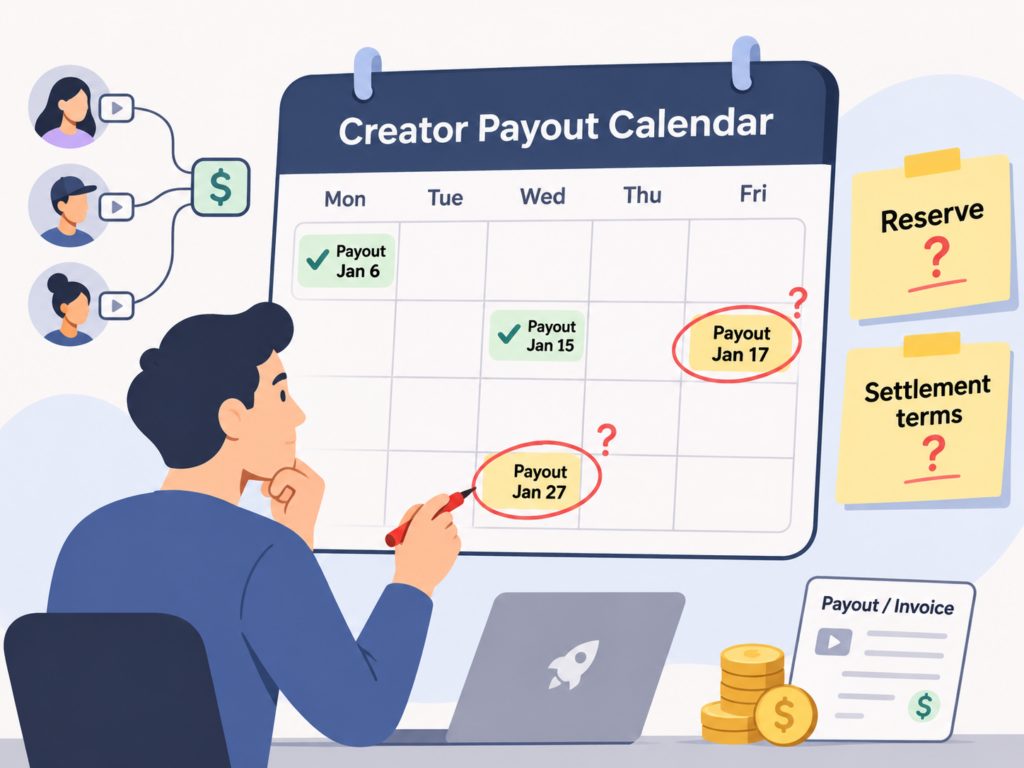
CCBill vs Segpay vs Verotel: one-glance comparison
The names do not describe identical arrangements. CCBill’s terms define its own net-payment rules; Segpay’s applicable account and settlement model must be quoted; Verotel presents itself through an IPSP-style service with distinct Basic and Premium choices. Compare legal role and money flow first.
CCBill publicly markets processing for adult cams, fan sites, content platforms, dating, and streaming, plus subscriptions, individual transactions, and tips. Its merchant terms say, exactly, “CCBill will issue payment to you on a weekly basis.” The same terms define net payment as consumer charges less items including CCBill fees, security deposit, prior refunds, chargebacks, delivery fees, taxes, and penalties. That is a cash-flow rule, not a promise that every applicant, country, price, or content model will be accepted. Ask for the current schedule attached to your own offer.
For Segpay, the current account role, recurring terms, one-time purchase support, pricing, refund authority, dispute process, and settlement route were not verified from an available official FAQ in this research run. Treat every one as unknown until a dated offer and technical test answer it. Verotel describes a service in which customer charges are collected and the merchant receives the resulting balance after stated deductions. Its published material separates Basic and Premium; the brief’s verified plan comparison says webcam billing is not included in Basic but is included in Premium. Do not blend those plans into one Verotel row in a procurement sheet.
If two offers pass the required checkout, renewal, cancellation, and refund flow, resolve the tie for this business. First protect audience access in the countries that actually buy. Next consider release cadence and whether eligible settled cash supports promised creator payouts. Then price the staff time needed to reconcile reports, answer disputes, and maintain integration changes. Finally compare lifecycle cost, including reserve pressure and exit work, not merely the visible transaction percentage. For a small multi-creator platform with payout obligations, cash clarity and operating capacity should beat a superficially lower but incomplete quote. A high-volume business with dedicated payments staff may weight the same factors differently.
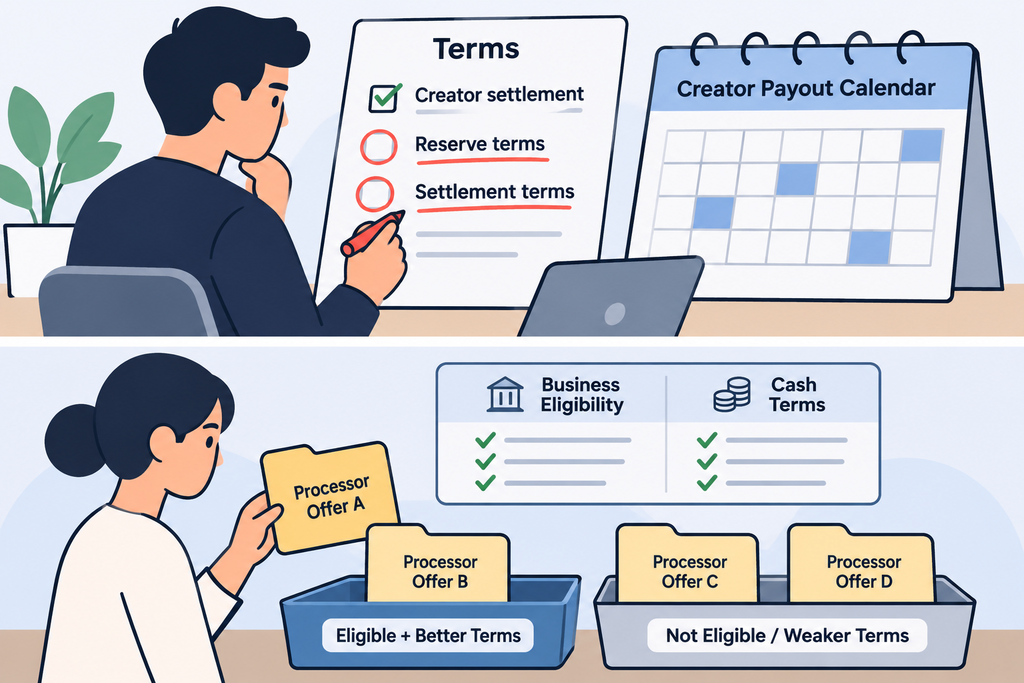
What reaches the bank is not gross sales
Available cash equals captured sales less refunds, processing charges, current reserve withholding, chargebacks and dispute fees, taxes, conversion, and payout-delivery costs, plus documented releases or credits. A reserve is withheld cash, not a second processing expense.
Use one period and one contractual calculation base. Start with captured gross sales and remove refunds once. Apply fees and reserves where the offer says they apply. Remove separate chargeback principal and fees, then add releases or credits payable in the period. Pending receipts do not fund creator payouts. Segpay’s reserve documentation says that during the first six months, up to 5% of revenues are held, and that returns begin in the seventh month through weekly payouts. That mechanism still does not establish a particular merchant’s terms.
Illustrative calculation, not a provider quote or customer result: suppose a multi-creator platform has 100 captured payments at a hypothetical $20 each, for $2,000 gross. Assume two $20 refunds. Remaining sales are $2,000 – $40 = $1,960. Assume a fictional 14% processing charge on that base: $1,960 × 0.14 = $274.40. Assume a fictional 5% reserve on the same base: $1,960 × 0.05 = $98. One separate hypothetical $20 chargeback plus a fictional $25 dispute fee removes $45. Cash available now is $1,960 – $274.40 – $98 – $45 = $1,542.60.
The payout ceiling is therefore $1,542.60 minus other obligations due, not $2,000. The refunded $40 was removed once and must not reappear as another cash deduction. Replace every fictional input with the written offer’s amount and basis, including whether a fee survives a refund or dispute. Add taxes, currency conversion, payout-delivery charges, earlier adjustments, and later reserve releases only when evidenced. In the transaction ledger, link each refund or chargeback to its original sale and reverse only the creator credit previously assigned to that sale under the platform’s disclosed policy.
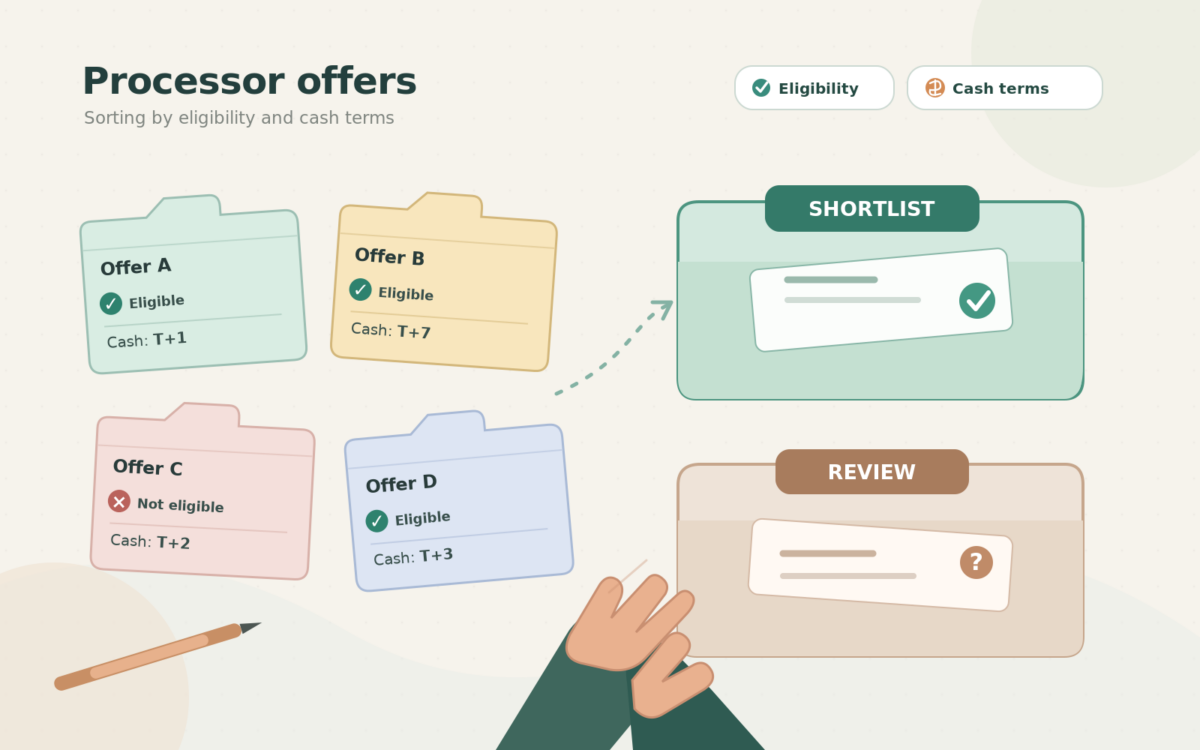
Six failure risks to resolve in writing
Pause the choice when eligibility, recurring rules, geography, reserve release, dispute operations, or exit treatment is unclear. Silence is not permission. Each question needs a written answer that finance and engineering can turn into a ledger event or test.
- Eligibility: Will you accept this exact content model, merchant entity, ownership, customer countries, creator relationship, and flow of funds?
- Recurring billing: Which initial charge, renewal, retry, price change, cancellation, and access-expiry events are supported and reported?
- Geography: Which merchant and buyer countries, settlement currencies, bank locations, or traffic sources are excluded or individually reviewed?
- Cash: What are every fee, reserve percentage and basis, release rule, settlement cutoff, delivery charge, conversion cost, and negative-balance remedy?
- Disputes: Who may issue refunds, how are notices delivered, what evidence and deadline apply, and where do principal, fees, and reversals appear?
- Exit: What happens to active subscriptions, stored payment authority, unpaid settlements, reserves, reports, cancellation access, and required customer notices?
Exit deserves attention before launch because a successful subscription book is not automatically portable. CCBill’s terms say it may hold funds for at least six months after cancellation and require the merchant to leave CCBill cancellation available while active transactions remain. Verotel’s agreement states, “Merchant is further obligated to honor any outstanding Codes” through the contracted subscription period. It also says uninvoiced customer charges or retained holdback are paid six months after the last merchant invoice following cancellation. These are provider-specific contract mechanics, not evidence that subscriptions can transfer. Require a written migration answer and test the proposed exit path.
Maintain one transaction record connecting the gross charge, provider reference, fee, reserve movement, refund, chargeback, settlement batch, access state, creator credit, and any creator-credit reversal. A refund should revoke or adjust access according to the product policy and reverse the linked credit once. A dispute notice should open a case with its evidence deadline and owner. If a sale already paid a creator, recover only the amount that policy assigned to that sale, not an arbitrary share of a later payout. This makes a provider report reconcilable instead of merely downloadable.
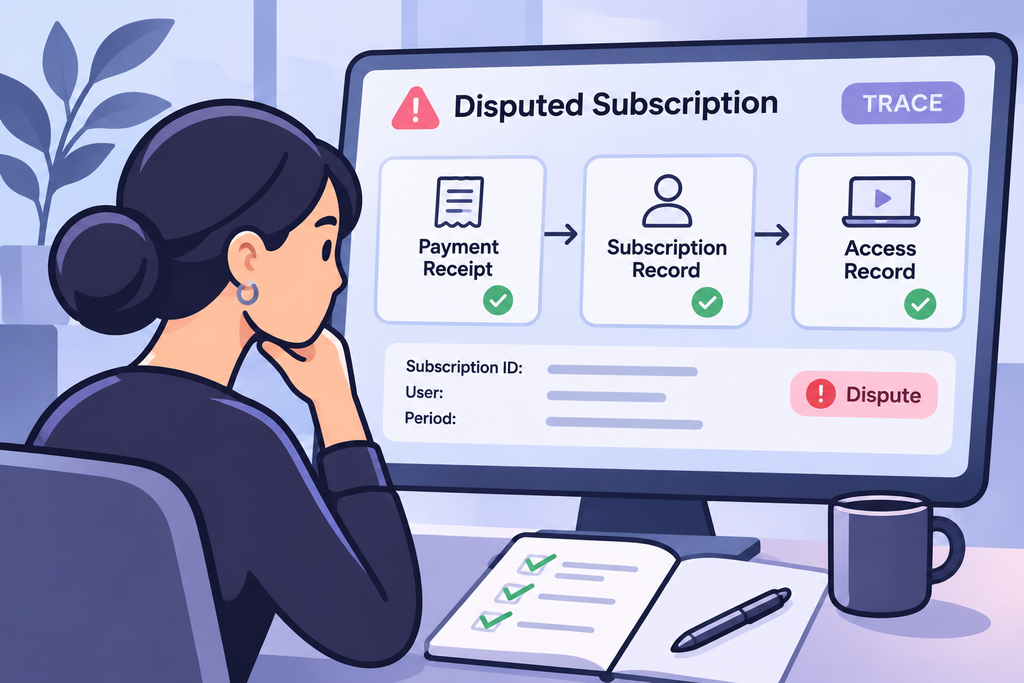
Three business scenarios, three different gates
The same method produces different shortlists. A new site needs low-volume clarity and clean recurring events; a multi-creator platform adds accepted funds flow and payout reconciliation; a webcam business adds explicit live-service acceptance and continuity planning.
For a new subscription site, request all three applicable offers only after the website describes price, renewal, cancellation, refunds, support, and content controls clearly. The default is the route that confirms the exact business and produces understandable renewal and cancellation events at the expected starting volume. The choice changes if low-volume charges, reserve rules, supported countries, or cancellation behavior leave cash or access ambiguous. Published adult support is an invitation to apply, not approval.
For the running multi-creator fan platform, the merchant entity receives processor settlement and the platform separately approves creator payouts. The default shortlist survives only if the provider accepts that declared relationship and the ledger can reconcile checkout, renewal, refund, dispute, and settlement. A hypothetical clean test, where every payment event updates the correct access state and the batch matches eligible cash, keeps the provider. A missing dispute notification, an unsupported marketplace-style funds flow, or a term blocking the required subscription exit changes the decision before launch.
For an established webcam business, confirm webcam billing, the exact live-service purchase types, expected volume, buyer geography, integration events, and migration obligations in writing. Verotel Basic and Premium are not substitutes here: the verified plan distinction places webcam billing in Premium, not Basic. CCBill’s adult page names adult cam among models that can start onboarding, but acceptance still depends on the application and offer. Segpay remains conditional because its necessary plan and feature terms were not verified in this run. The deciding failure is any gap in accepted activity, continuity, settlement, or exit, not brand familiarity.
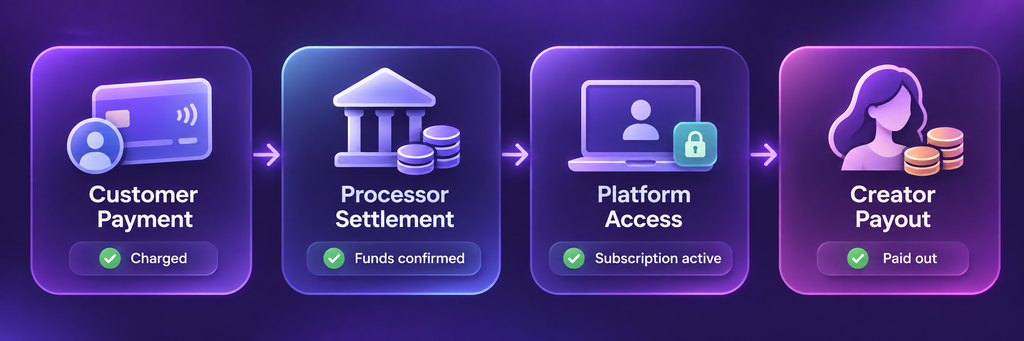
From application to a reconciled test purchase
Finish the provider’s current document and website requirements, connect payment events to access, and test purchase, renewal, failed renewal, cancellation, refund, and dispute. Approval alone does not prove that money, access, and creator records reconcile.
Completed readiness example for the hypothetical fan platform: the task is to approve creator payouts from one subscription batch. Start-readiness requires the signed offer, declared content and funds flow, complete public pricing and renewal terms, business and bank records, owner identification, creator identity and consent evidence, moderation and complaints process, plus named finance and engineering owners. The operations lead checks those artifacts. If one is missing or the provider has not accepted it, the batch cannot start and onboarding returns to the responsible owner.
Completion means test evidence links purchase, payment confirmation, access grant, renewal, failed renewal, cancellation, refund, access change, dispute notice, settlement line, and creator-credit reversal to provider references. Finance owns the settlement match; engineering owns event delivery and access state; operations signs the joint result. Observable proof is an exported transaction trail plus provider report whose eligible settled cash matches the platform ledger. If either proof fails, pause payouts, repair or renegotiate, and rerun the failed path. Do not fill the gap with pending or reserved receipts.
Scrile Connect currently provides CCBill and NETbilling card integrations, including recurring subscription billing, subject to provider approval and project scope. Segpay and Verotel are comparison candidates here, not ready-made Connect integrations; either requires technical review. Scrile is the platform software provider, not the processor or merchant of record. The merchant receives provider settlement and separately manages creator payout requests. Crypto procurement is outside this card comparison, although Scrile can configure Zyrox for crypto subscriptions and one-time purchases. For broader implementation context, payment processing for creator platforms matters because access events, reporting, and payouts must agree even after checkout succeeds.
Selection checklist and next step
Select only after eligibility, legal role, billing events, total charges, reserve release, settlement, disputes, refunds, and exit are written, then require the money-and-access test to pass. An unknown remains a stop gate.
The final decision is deliberately plain. The offer must accept the entity, content, countries, buyer relationship, and funds flow. It must describe the required purchase and subscription events, all charges and reserve releases, settlement delivery, refund authority, dispute notices, and exit treatment. Legal and finance review the dated offer; engineering proves the event flow; operations confirms the site and content process. If several routes pass, choose the one this team can operate and reconcile at an acceptable lifecycle cost, while keeping creator payouts below eligible settled cash.
Filled pass/fail check from the running scenario: task, approve Friday’s creator payout batch. Ready means finance has the signed reserve and settlement schedule and engineering has mapped every required provider event. Complete means the test subscription’s purchase, renewal, refund, cancellation, dispute notice, access change, settlement, and creator reversal share one traceable transaction history. Proof is the signed offer, event log, and reconciled settlement report. Finance is check owner, with engineering attesting to access events. If readiness or completion fails, payouts stay paused and the team fixes the integration, renegotiates the term, or changes provider before repeating the test.
That test returns to the Friday payout screen. If the provider report and platform ledger reconcile, the owner can keep the shortlisted provider and schedule payouts from documented eligible cash. If the reserve is still undefined, the dispute event never arrives, or the exit path cannot preserve required customer treatment, the choice changes. The solution is not to assume gross receipts will cover the gap. It is to obtain a usable offer or choose a route that passes the same test.

Watch: how to prevent chargebacks before they reach your provider
Whichever gateway you choose, disputes count against you. This 2-minute video shows five checks that reduce them.
Connect the provider decision to the platform
Once a written card-processing offer passes the cash and event tests, Scrile Connect can provide the creator-platform software and supported payment integration under your own brand. Provider approval and charges remain separate, and your business keeps the merchant relationship and controls creator payouts.
Frequently asked questions
What is the difference between CCBill and Segpay for adult subscription sites?
CCBill’s public material confirms adult-business and subscription tools, while its terms describe weekly net payments and possible deductions. Segpay’s applicable account role, recurring terms, pricing, and settlement route need current official confirmation because its FAQ evidence was unavailable in this run. Compare dated offers for the same entity and billing flow.
How does CCBill compare with Verotel for adult platforms?
Compare CCBill’s individually applicable offer with the relevant Verotel plan, not with Verotel as one blended product. Check accepted content, billing events, reserve, net settlement, disputes, and exit. Verotel Basic and Premium differ, including the verified webcam-billing distinction.
How does Segpay compare with Verotel?
Match Segpay’s current written model and quote against either Verotel Basic or Premium for the identical business. Segpay’s published reserve documentation describes withholding and later returns, while other decisive Segpay terms remain offer-specific or unverified here. Do not infer them from silence.
Which provider fits a new adult subscription site?
The provider that confirms the exact business, country, billing flow, and complete cash terms in writing, then passes purchase, renewal, cancellation, refund, dispute, access, and settlement tests. A new site should not select from headline rates alone.
Should an adult platform start with subscriptions or one-time payments?
Use subscriptions for repeat access with clear renewal and cancellation behavior. Use one-time payments for discrete unlocks. Choose from demonstrated buyer demand and the access promise, then verify that the provider reports every required event before launch.
How are processing fees different from rolling reserves?
A processing fee is an expense charged under the agreement. A rolling reserve is cash withheld against later exposure and released only under stated terms. Both reduce cash available now, but only a documented reserve release returns withheld funds.
What do adult payment processors usually require for approval?
Requirements vary, so obtain the provider’s current checklist. Prepare entity and bank details, owner identification, the live site, pricing and renewal disclosures, refund and cancellation terms, contact details, and requested evidence for creator identity, consent, moderation, and complaints.
Which card payment providers does Scrile Connect support today?
Scrile Connect currently has CCBill and NETbilling card integrations, including recurring billing, subject to provider approval and project scope. Segpay and Verotel require technical review and should not be presented as ready-made Connect integrations.
